
A life-saving heart procedure once out of reach for many in Tarrant County is now available at JPS Health Network, bringing advanced cardiac care closer to home. Thanks to the newly established Transcatheter Aortic Valve Replacement (TAVR) program, individuals facing the life-limiting effects of severe aortic stenosis now have access to a minimally invasive, high-impact treatment that restores vitality and extends independence–dramatically improving both survival and quality of life.
“Left untreated, severe aortic stenosis with symptoms has a very high mortality rate,” said Saba Asad, MD, Chief Medical Officer for JPS Health Network. “TAVR offers a lifesaving alternative and significantly improves quality of life. It's especially well-suited for older patients who can't tolerate traditional open-heart valve replacement surgery. Currently, TAVR is considered the standard of care for isolated aortic valve stenosis in older adults.”
The program represents a major milestone for JPS and the patients it serves. Traditionally, those diagnosed with aortic stenosis were referred to other hospitals for TAVR. Many couldn’t make the trip due to cost, transportation barriers, or other social factors. Now that critical care is available close to home, JPS continues to fulfill its mission of removing barriers to care and ensuring every patient has access to lifesaving treatment.
“Now I walk my puppy down the street, cook for my family, and even drive again. Life is good at 70!”
Jessica Creel, MSN, RN-BC, CVN, Structural Heart Program Coordinator at JPS, helped bring TAVR to life at JPS.
“These procedures weren’t done at JPS before; they had to be referred out,” said Creel. “Now, we’re offering a minimally invasive option that allows patients to go home the next day and feel better almost immediately.”
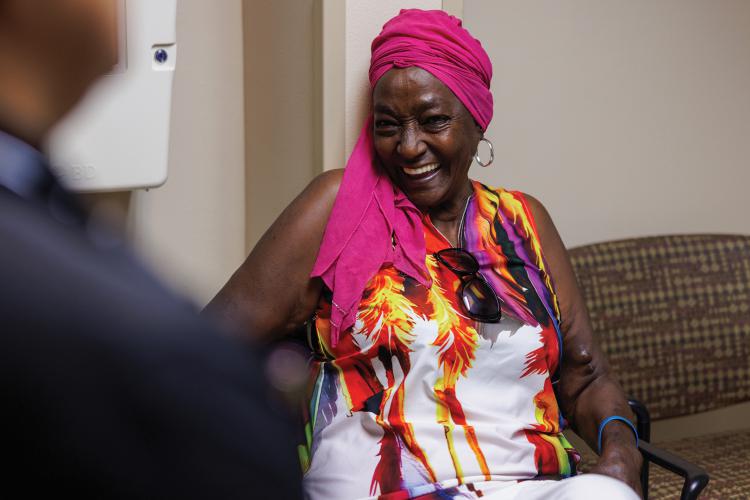
For patient Cheryl Rita Hogan, that difference was life-changing.
“Before the procedure, I couldn’t take four steps without being out of breath,” Hogan said. “Now I walk my puppy down the street, cook for my family, and even drive again. Life is good at 70!”
TAVR replaces the diseased aortic valve with a new one, without the need for open-heart surgery. Instead of making a larger chest incision, interventional cardiologists use a catheter inserted through a blood vessel, typically in the groin, to guide the replacement valve into position. This procedure has helped improve the quality of life for patients, while also making recovery time for patients substantially lower.
“This procedure is revolutionary because it allows us to replace the aortic valve without a chest incision,” said Juzar Lokhandwala, MD, Interventional Cardiologist at JPS. “Patients can walk the next day and get back to their lives quickly.”
Hogan remembers that day vividly. She recalls the doctors’ reassuring voices and the moment she realized that everything was going to be alright.
“The doctors came in, and they were so kind,” said Hogan. “They said, ‘Don’t worry. We’ve got you in our hands.’ And they did. The next day, I was ready to go home.”
This shift toward less invasive care is a game-changer for patients living with aortic stenosis, as many experience relief from their symptoms within days after TAVR.
“Before the procedure, patients are very short of breath and fatigued,” said Dr. Lokhandwala. “After TAVR, there’s a dramatic improvement; they’re breathing better, walking more, and feeling functional again.”
Hogan urges others with aortic stenosis to take the opportunity if it’s available to them, sharing that the procedure gave her back the ability to enjoy everyday activities and live life fully again.
“If anyone has a heart murmur and the doctors tell them they need a TAVR, please listen. You’ll feel so much better, I know I do,” Hogan said.

Behind every TAVR procedure is a coordinated, multidisciplinary team that includes interventional cardiologists, cardiothoracic surgeons, anesthesiologists, and catheterization lab and operating room staff. Each patient is carefully evaluated by multiple specialists to ensure the safest and most effective treatment.
“TAVR is truly a team effort,” said Dr. Lokhandwala. “Every case is reviewed collaboratively. That joint decision-making is what ensures our patients are getting the safest, most effective treatment possible.”
The journey to launching the program was years in the making. JPS had to meet national registry requirements, demonstrate physician experience, and conduct multiple test runs to ensure every detail, from equipment setup to emergency response, was ready.
“We had to show that our team had the experience and infrastructure,” Creel said. “We joined national data registries, trained our staff, and built everything from the ground up.”
For Hogan, this procedure offered a new beginning. The TAVR helped restore her heart function and renewed her confidence, independence, and joy. She is a testament that advances and compassionate care can give patients their health and life back.
“I will tell anyone going through a health problem: don’t be afraid,” Hogan said. “JPS has some of the finest doctors in the world. Trust your care team, trust God, and choose life. It’s all about life.”